Psyche
Your history, relationships and recurring patterns.
Therapy that connects your patterns, your feelings and the choices available to you.
We explore them together, at a pace that fits you.
Your history, relationships and recurring patterns.
What you feel in your body and emotions, and how you respond.
Your needs, boundaries and capacity to choose and act.
Making sense of how your experiences, feelings and responses influence each other.
You might understand why saying no is difficult, yet still feel guilty when you try.
We can explore where that guilt comes from, how you experience it, and what boundary feels possible now.
A shared map can help. You choose the words and images that fit; we can also work without one.
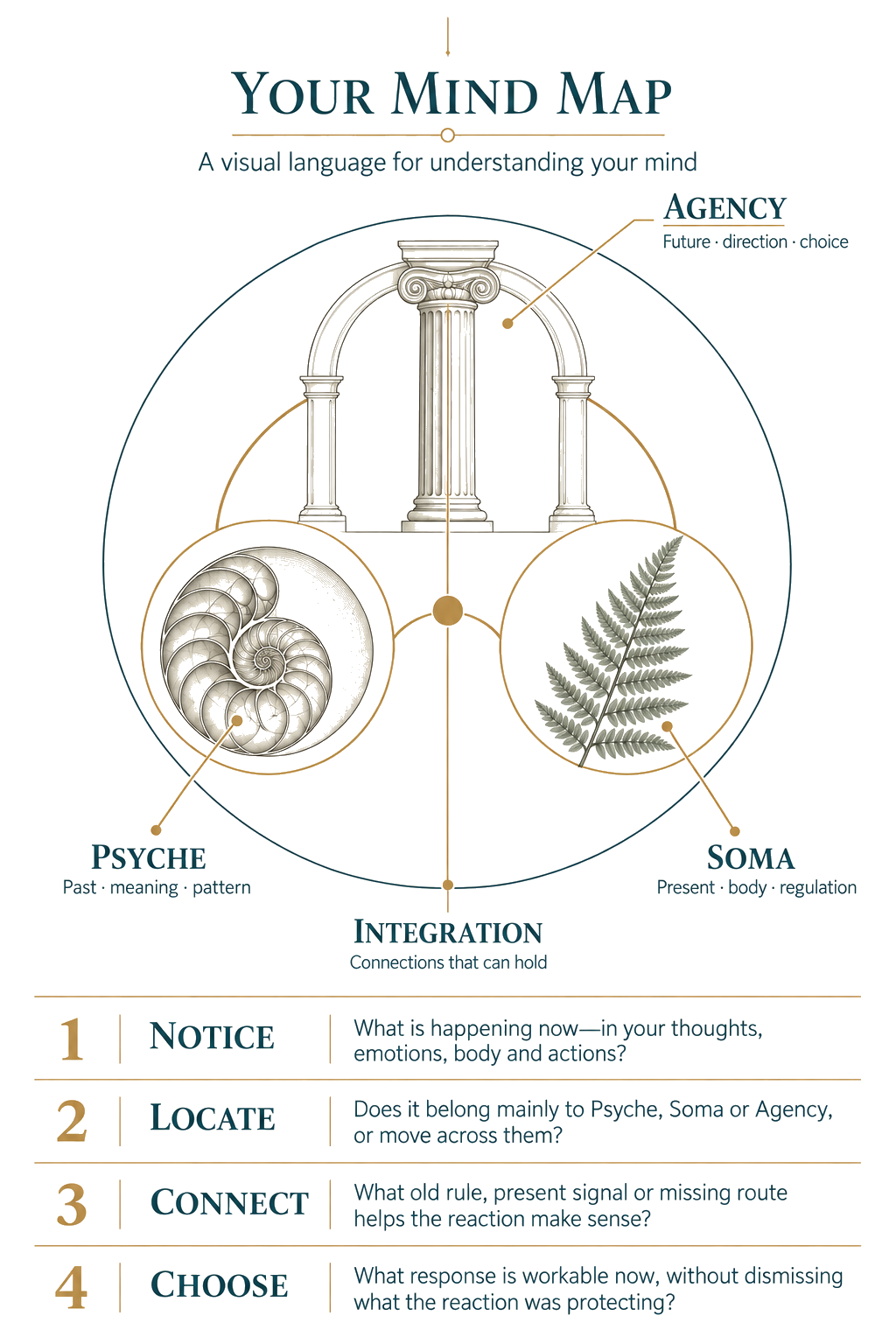
I developed OMM within my integrative practice. Its foundations are psychodynamic and relational, alongside DBT-informed skills and somatic-informed awareness. We combine understanding with practical ways of responding.
Understanding a pattern does not always make it easier to change. Skills can also feel disconnected from your experience. OMM aims to connect personal meaning, emotional awareness and choices that feel your own.
Understanding a pattern does not always change what happens when you feel stressed, threatened or overwhelmed. We can use the map to explore what you understand, what happens in your body, and what makes a different response difficult in the moment.
You might agree to extra work even when you are already stretched, then feel tense, resentful and guilty. Through Psyche, we might explore what saying no means to you; through Soma, notice the pressure you feel; and through Agency, consider a manageable response, such as asking for time before agreeing.
These are possibilities to explore together, rather than conclusions drawn from a single behaviour.
We may explore earlier experiences when they help us understand something happening now. We also pay attention to your current relationships, circumstances and pressures, without assuming that every difficulty comes from the past.
No artistic ability is needed. Your map can use simple words, lines, symbols or notes—the aim is to make connections easier to see and discuss.
The map is a working picture of your experience, developed together. It can include patterns, strengths, relationships and pressures, but it does not function as a diagnostic test.
Your disagreement is useful information. We can question an interpretation, change the wording or remove a connection that does not fit your experience.
Body awareness is optional, and we can adapt or pause an exercise. We might instead focus on your surroundings, conversation, practical support or another approach that feels more manageable.
We move between the three according to what is useful and tolerable at the time. Some sessions may focus on understanding a relationship pattern, while others may involve noticing your state or considering a practical next step.
Yes—the map is provisional and revisable. As we learn more, we may add connections, reconsider assumptions or recognise that a pattern works differently in different situations.
We may agree on something to notice, reflect on or try between sessions, where that supports your goals. Workbook exercises can be used selectively, and we can discuss what fits your time, energy and circumstances.
We will review the goals that matter to you and look at changes in everyday life. These might include recognising a pattern sooner, recovering more easily after a difficult interaction, or having more choice about how you respond.
The Open Mind Method is a developing integrative framework that draws on established therapeutic approaches. It has not yet been independently evaluated; research supporting those approaches does not establish the effectiveness of OMM itself.
Research is still needed to establish how well the framework works as a whole, and its potential benefits should be discussed without promises or guarantees.
Start with a free 15-minute conversation.